

Disclaimer: This article was written in early April 2025. Given the rapid pace of developments in Generative AI and LLM, some information might quickly become outdated.
Now that LLMs are no longer a secret weapon and everyone’s jumping on board, I’ll confess: we’ve quietly integrated AI into our design studios since January 2023. Fast forward to mid-2025, and I’m still pushing our studios even harder — not because we’ve become AI-dependent, but because these generative AI tools have taught us something unexpectedly human: how to trust our design instincts more deeply and make those instincts measurable — even quantifiable. Go ahead — judge me.
Quietly Revolutionary: Overcoming Designers’ AI Skepticism
Two years ago, as designers, we faced a common dilemma: “Is AI just hype for designers?” Skepticism was natural — and job insecurity, a very human reaction. Designers cherish creativity, intuition, and human connection — qualities we believed robots and algorithms could never replicate or meaningfully enhance.
However, because we work with large clients who expect us to solve real problems and ultimately deliver business outcomes — not just produce aesthetically pleasing results — our curiosity led us to quietly integrate AI into our workflows. We started small, cautiously experimenting with tools while maintaining our human-centered approach.
We began exploring powerful Large Language Models (LLMs) such as OpenAI’s GPT-3 through 4.5, Claude by Anthropic, Qwen 2.5 from Alibaba, the famously disruptive DeepSeek R1, and the fastest among them: LeChat from Mistral. Initially, we used them for straightforward administrative tasks like drafting to do list and summarizing meeting notes. But soon, their potential expanded. We found they could help evaluate complex design problems, propose creative alternatives, and critique our work with a level of precision that made us rethink our approach.
Design Isn’t Random: Lessons from the Design Machine Group
During my research at the Design Machine Group (DMG) at the University of Washington in Seattle, my professor and mentor shared a lesson that has stayed with me ever since: “Art and Design are not random process. Behind great art and every good design and the aesthetics they expressed can be explained through quantifiable measures. Sometimes, our limitations in science prevent us from articulating them clearly.”
That wisdom continues to shape how I lead our designers. It also opened my mind to using generative AI — not as a replacement, but as an analytical partner to clarify, validate, and strengthen our intuition-led decisions. In fact, we often run multiple LLMs in parallel on a single project to cross-check logic and ensure our conclusions are sound.
These LLMs augment our decision-making with quantifiable metrics, calculations, and structured reasoning. For example, with every master plan or architectural design package we deliver, we produce a detailed “Development Summary” — a breakdown of program areas, efficiency ratios, and functional analysis. Today, that summary is generated entirely by LLMs, and it has transformed the way we work from the very beginning of the design process.
When faced with tasks that require quick turnaround — like simulating a superblock development in a prime area of Jakarta — the Development Summary, once considered a post-design deliverable, now becomes our initial programming guide and design directive. Before generative AI tools like OpenAI, Anthropic, and others became accessible, this kind of programming took at least a week of trial and error attempts. Today, we can accomplish the same in less than half a day with help from LLMs.
AI has given us the ability to measure and deconstruct aspects of design thinking we used to describe to non-designers as “black box” thinking — a gut feeling we couldn’t fully explain. Now, with generative AI, we’re turning that black box into an open one. Rather than undermining intuition, AI has enhanced it — bringing clarity, measurable validation, and actionable insight to the heart of our design process.
Real-World AI Integration: Practical Stories from Our Studio
Taksadana: Clarifying Complexity in Land Valuation
Land valuation in Indonesia, particularly outside major urban centers, is notoriously complex due to varying legal statuses, historical transactions, infrastructure planning and construction, and local socio-economic conditions. Traditionally, banks and financial institutions relied on incomplete datasets, resulting in conservative and often unfair valuations. Our studio addressed this challenge through Taksadana (we come up with the name), an AI-driven financial land-use platform. While it is still under development with assistance from low-code and no-code processes — thanks to generative AI — we have carefully laid out the thinking process and outcomes manually.
By combining machine learning algorithms with extensive datasets — including satellite imagery, historical land use records, and proximity to key infrastructure — we significantly enhanced valuation accuracy. Crucially, qualitative data collected from local communities enriched the AI training process, enabling the algorithm to capture nuanced socio-economic factors. The result? Landowners received fairer, more accurate valuations, and financial institutions confidently extended more equitable loans. We’ve applied this very thinking process to our ongoing projects, resulting in better land valuations from banks for developments we’re involved in. For us as a business, this means our design and research fees are easily covered, through the added value — often multiplied tenfold — our analysis provides.
Master Plan Optimization: Data Meets Design Intuition
When developing master plans for complex mixed-use projects, balancing multiple stakeholder needs has always been a significant challenge. Human intuition alone, while valuable, often left room for costly oversights or inefficiencies.
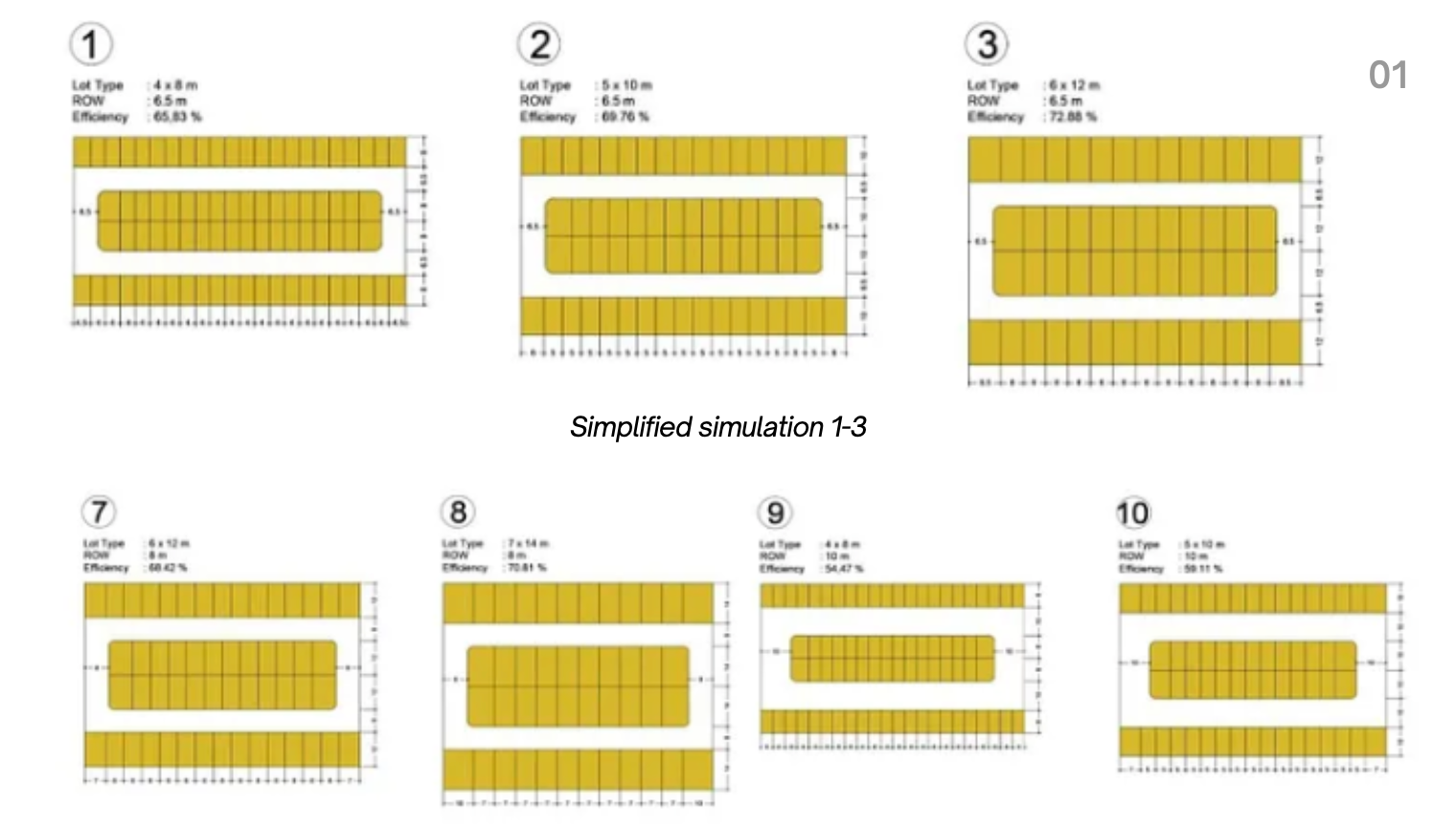
We introduced AI-based regression analysis to quickly evaluate hundreds of master plan configurations. In one notable project in Greater Jakarta, AI optimization helped us identify a layout that increased usable area by 22% and reduced overall infrastructure costs by optimizing the placement of infrastructure and residential lots. This process, which previously took weeks of manual iteration to generate and compare design options, now takes a fraction of the time. Our designers can easily identify optimal lot sizes and infrastructure configurations even before drawing the first line.
Rather than feeling threatened, our design team embraced AI as a reliable advisor, amplifying their instincts with concrete, measurable outcomes.
Internal LLM: Democratizing Knowledge
While English remains the most effective language for communicating with LLMs, global models — though undeniably powerful — often lack the granular knowledge needed for Indonesian-specific design contexts. To bridge this gap, we are in the process of curating these readily use LLMs and eventually we plan to build our proprietary Local Large Language Model, trained explicitly on our studio’s accumulated project documentation, design decisions, research findings, and field experiences.
To our knowledge, no one has yet created a taxonomy of LLMs categorized specifically for local contexts or specialized scientific domains and purposes. Internally, we’ve curated and benchmarked models best suited for urban design, architectural standards, and localized language use — particularly for Indonesian contexts.
This internal LLM initiative has already allowed junior team members to access senior-level insights on demand, facilitating a democratization of knowledge that was previously siloed. The result is an empowered, more agile team capable of rapidly absorbing and applying hard-earned experience to new, complex projects with greater confidence and efficiency.
Community Matters: Our “Learn Without Lunch” Initiative
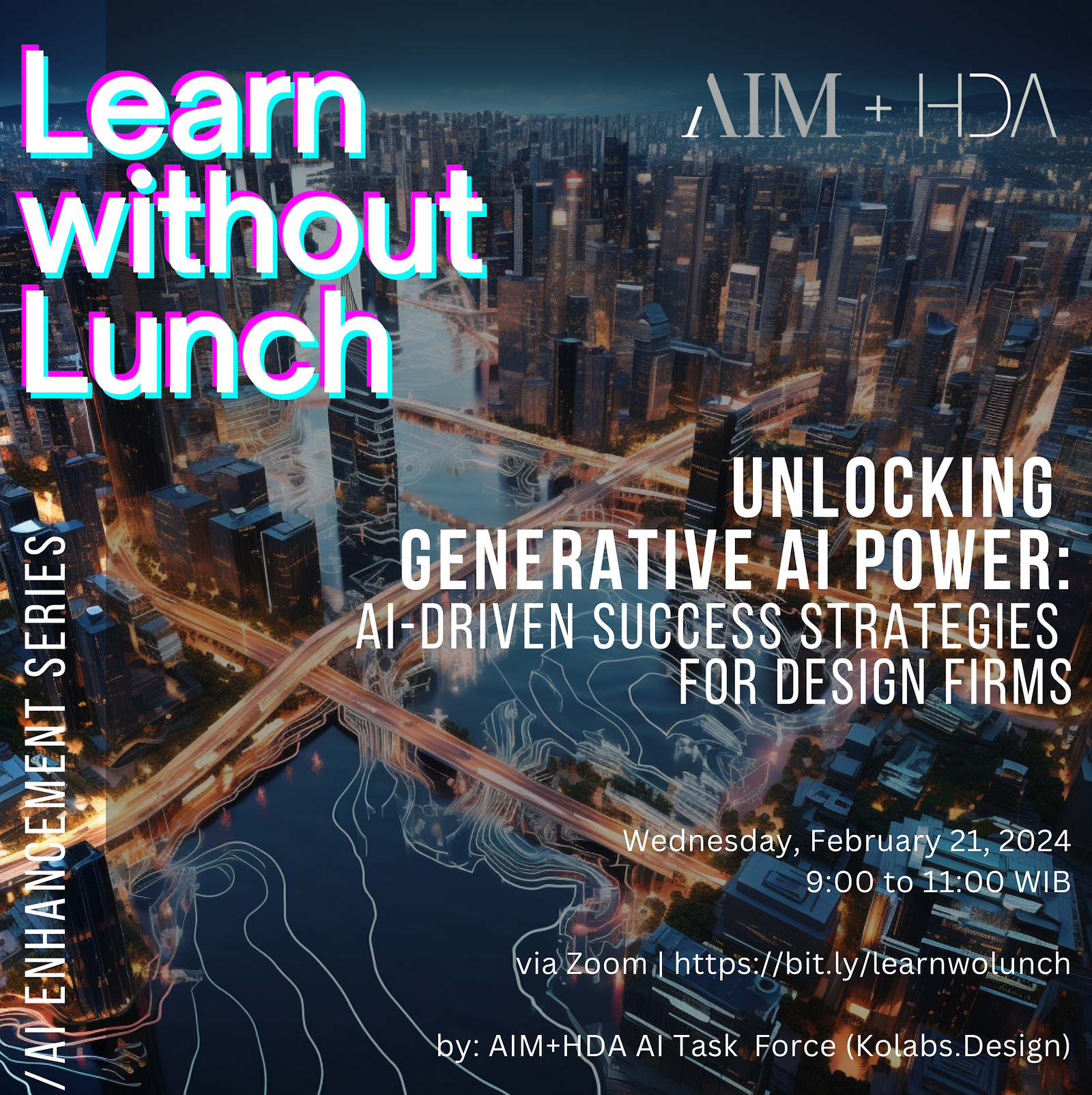
The COVID-19 pandemic disrupted our traditional “Lunch and Learn” sessions — a vital component of our studio learning culture. These sessions allowed us to cross-learn from each other’s curricular and non-curricular knowledge. To adapt during the pandemic, we transitioned these gatherings online and rebranded them as “Learn Without Lunch.” Despite the physical separation, the virtual sessions became even more enriching.
In this new AI-driven era, our Learn Without Lunch sessions have covered a wide range of topics — from benchmarking AI tools and exploring prompt engineering techniques to sharing lessons learned from how our team members interact with generative models. One particularly insightful practice introduced by a studio researcher was to treat AI more like a human counterpart. He suggested naming the models with human or pet names — so instead of saying “Hi Chat” or “Hi ChatGPT” or “Hi Claude”, we refer to them personally for example as “Monty” or “Sera.” This seemingly small shift narrowed the perceived gap between human and machine, allowing us to treat AI less as a tool and more like a design associate — or a very capable intern that can be asked to perform a variety of tasks without hesitation.
These monthly Learn Without Lunch interactions have helped maintain our studio’s community spirit, fostered resilience, and significantly elevated our AI literacy and hands-on application. They’ve served as a continual reminder that technology’s best use is not to replace human connection, but to amplify it. them.
Strategic Integration: Beyond Meeting Minutes
Beyond internal applications for our design leadership, our designers, our researchers, and our operational team, we took proactive steps to spread the word to our clients. We aimed to educate major corporate clients and conglomerates about the true potential of these technologies. During our roadshows across several large client organizations, we discovered that many of their staff were already using LLMs for daily tasks.
However, rather than relegating these tools to mundane uses like automated meeting notes, we demonstrated how strategic integration could reshape entire organizational workflows, unlock innovative business models, and elevate decision-making processes. This initiative wasn’t just for their benefit — helping our clients successfully adopt these tools creates new value and opportunities for both sides of the relationship.
These roadshows significantly shifted client perspectives, repositioning our studio not just as technical experts but as strategic partners in their transformation efforts. One key message we emphasized was the importance of building AI literacy across all levels of the organization — from using it for simple tasks to leveraging it for business reasoning and executive decision support. We strongly encouraged a top-down approach, urging leadership to embrace these tools and set the tone: AI is not a threat or a shortcut — it’s a strategic capability.
Thought Leadership: AI in Property Development
Our commitment to thought leadership culminated in publishing the booklet, “Profit Engine: AI as a Driver of Property Business.” This document distilled actionable insights and strategies for property developers to leverage AI for higher profitability, efficiency, and competitive advantage.
We distributed the booklet in PDF format to dozens of our clients across various sectors. In the publication, we explained not only why but how we’ve been incorporating generative AI into the actual work we do for them. Without revealing client names or confidential project details, we openly shared our methodologies and step-by-step workflows — something rarely done in our industry. We believed that offering this level of transparency would not only benefit our clients but also spark new ideas and inspire broader adoption within their organizations.
We were initially hesitant to share these techniques. In a competitive industry, openness is risky. But we ultimately recognized that sharing our approach could create greater value — not only for clients who are ready to adopt but also for those just beginning their journey. The success of our clients in leveraging these tools creates a ripple effect that benefits their business outcomes and, in turn, deepens our collaboration.
Since releasing the booklet, we’ve received a variety of feedback. Some clients have already applied this knowledge thoroughly — reorganizing workflows, retraining teams, and embedding generative AI into their daily decision-making. Others are still new to it, taking early steps or exploring how these ideas could be introduced internally. For both, the booklet served as a catalyst — an approachable entry point into an otherwise complex and technical field.
The publication garnered positive responses, reinforcing our studio’s reputation and credibility. It led directly to new partnerships, deeper collaborations across teams, and increased interest from stakeholders in Indonesia and internationally.
GPT-4o Image Creation: A New Frontier
As designers, we are deeply connected to the visual world. Naturally, we’ve paid close attention to the evolution of image-generation tools. While platforms like DALL·E, Flux, and Leonardo have demonstrated impressive capabilities, we’ve long felt that AI-generated images weren’t quite suitable for the rigor, precision, and storytelling required in our architectural and urban design work. As a result, we’ve continued to rely on our in-house designers and rendering teams for high-quality visualization.
That is, until this past week.
With the release of GPT-4o by OpenAI in late March 2025, a new door has opened. This multimodal model doesn’t just generate text — it creates highly detailed images with remarkable alignment to prompts, strong contextual memory, and even the ability to interact with uploaded sketches or references. Its fluency in bridging chat context with visual outcomes makes it uniquely promising for early-stage concept exploration and design communication.
For the first time, we’re genuinely evaluating how AI-generated visuals could complement — and possibly accelerate — our design workflows. We see its potential in ideation, scenario simulation, and even iterative feedback loops with clients who may struggle to visualize abstract ideas. However, we remain cautious and are committed to testing its limits thoroughly before full integration.
We plan to conduct internal benchmarks and creative trials across a range of project types. Once we complete our evaluation, we’ll share our findings in a follow-up article here. Stay tuned — because what feels like a novelty today could very well become tomorrow’s visual co-pilot.
Conclusion: Robots Made Us More Human
Like it or not, my experience has been incredibly fruitful. There are, of course, many challenges in working with AI — getting comfortable with machines, ensuring data privacy as we handle confidential client projects, and learning how to communicate effectively not just through words, but also through visual cues.
And yet, robots don’t have feelings. You can talk to them at any time. You can ask what might sound like the dumbest question without fear of judgment. That alone is liberating. As someone with years of design and business experience across various regions of the globe, I still have questions every day — and I never pretend to know everything. These LLMs have become reliable companions in that journey.
Beyond design, these AI companions help us in many aspects of our work life. For example, working across time zones and constantly shifting between roles, we’ve asked them to support creative writing and even structuring reports. For transparency: I wrote this article myself. All the thoughts, reflections, and experiences shared here are my own — and ours as a studio — but I used LLMs to help refine language, check spelling, and find the right phrasing. They were my editing partner, not my voice.
The most powerful lesson from our two-year journey is remarkably simple yet profound: integrating AI has made us more thoughtful, more deliberate, and more human as designers. AI hasn’t replaced our creativity; it has sharpened and validated it.
Looking ahead, our studio remains committed to exploring and integrating evolving technologies. We’re guided by one principle: technology’s ultimate value lies in amplifying human potential, clarifying human intuition, and strengthening human connections. Paradoxically, it is this unexpectedly human lesson that AI has taught us best.
See you in our next “Lessons Learned” from the studio.
Doddy Samiaji is a design leader and leads designers and researchers at KOLABS.DESIGN, HDA and AIM in Indonesia.