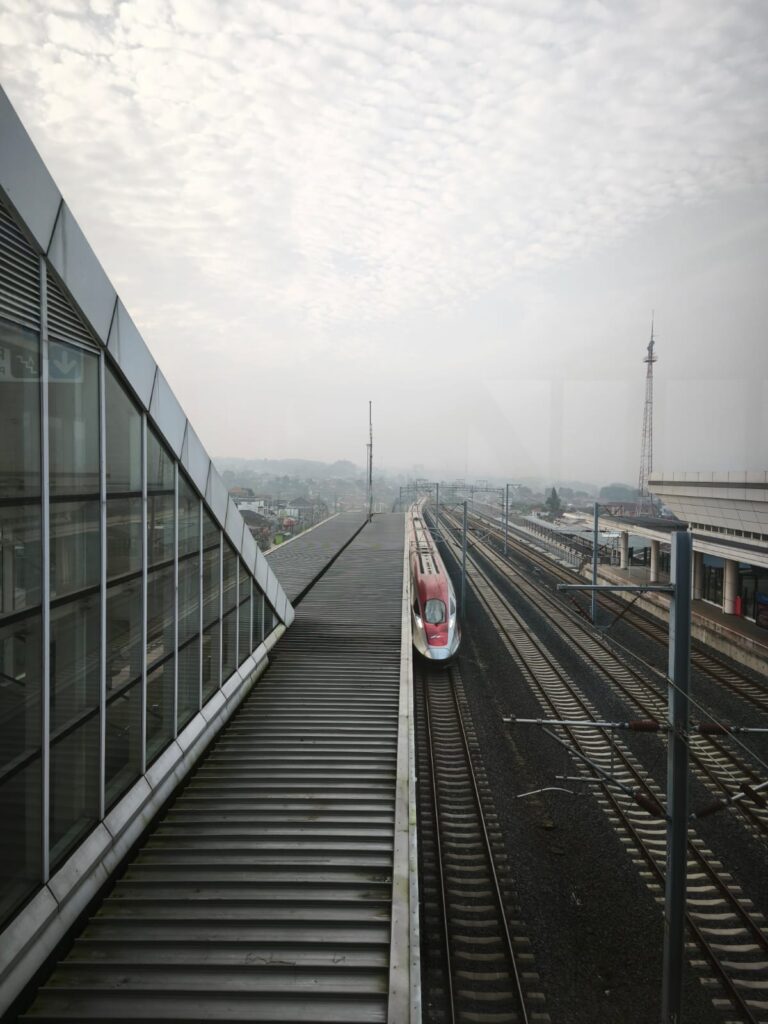
The Whoosh Effect: How a Train System is Redefining Culture
When HDA began designing the new Bandung Central Station, we knew we were contributing to a piece of future infrastructure. But what we didn’t expect was how much the Whoosh high-speed rail would become a mirror — not of technology, but of cultural evolution.
The first time I rode early trial of the Whoosh train as part of HDA design assignment, it wasn’t just the 347 km/h speed that struck me. It was how the ride felt: seamless, dignified, modern. Today, I take it weekly. And every time, I see a different Indonesia inside that cabin. This is a story not about design plans, but about what design sets in motion.
A New Time Culture
In a country where being late is often a tolerated norm, Whoosh flips the narrative. With its fixed, uncompromising schedule, it introduces a culture of precision. I remember watching over a dozen passengers left on the platform at Padalarang, shocked — they had missed the train by just two minutes. The doors had closed. The train had left. No negotiation.
This moment is liberating. Finally, something in Indonesia was demanding we treat time as a shared contract. Not fluid, but firm. Not approximate, but real.
And with that shift, something subtle happened: people started arriving early. Packing lighter. Planning better. Public infrastructure was no longer just a convenience. It was reshaping behavior.
Beyond Transit: A Reset of Dignity
Historically, Indonesian public transport has carried a stigma. Buses and trains were for those without choices. Cars meant success. Motorcycles meant freedom. But Whoosh disrupts this social code.
Inside the train, you see executives rehearsing slides. Students laughing over snacks. Families sharing photos. Ibu-ibu Arisan groups chatting calmly. No one is “above” this experience — everyone is simply human, together. This is what well-designed mobility looks like: not just efficiency, but inclusion.
When President Jokowi invited influencers and officials to ride the Whoosh, he wasn’t showing off. He was repositioning public transport as aspirational. HDA believes this matters deeply: when infrastructure invites everyone in, it becomes more than a system. It becomes a shared narrative.
The Ripple Effect of Seamless Mobility
A transport system is never just one thing. The Whoosh is a spine that connects many other systems — LRTs, BRTs, local buses. When we designed Bandung Central, we knew this node had to act like a clasp in a larger necklace — holding together many strands of mobility.
And it works. Ridership in Jakarta’s LRT has risen. Bus networks have grown in appeal. Even BRT systems once seen as “lower-tier” are now getting upper-class riders transferring off the Whoosh. The entire network benefits — because when one mode becomes excellent, it lifts the others.
This is intermodality as culture, not just logistics. A belief that the journey is no longer fragmented, but stitched into one flow.
The Quiet Revolution of Punctuality
I once sat beside a businessman who, as the train departed, calmly looked at his watch. There was no anxiety. No toggling between apps. No need to check traffic on Jalan Tol Padalarang Cileunyi nor Jalan Tol Cikampek. He knew he would arrive in Jakarta on time — just in time for his 10:00 AM meeting in Senayan.
He had boarded at 8:38 AM.
That’s the power of trust. Not in promises, but in systems. And when systems perform well, they shape how people move, think, and work.
Bridging Class, Geography, and Aspiration
Whoosh isn’t just a train between cities. It’s a bridge across strata.
For HDA, this is where the design challenge always lives: How do we build environments that don’t just function, but reorient cultural mindsets? When families from suburban West Java ride the same train as top executives, when all are equally served and comfortable, something shifts. The city gets reshaped. So does the imagination of its people.
In architecture, we talk about “thresholds” — the moments between spaces, where transformation begins. Whoosh is that threshold, not just between Jakarta and Bandung, but between what Indonesia has been and what it is becoming.
A Greener, Smarter Future — And Proof It Works
The environmental upside is real. Whoosh helps take cars off roads, reduce emissions, cut noise pollution, and ease stress. This isn’t theoretical — it’s felt.
At HDA, we often work on transit-adjacent sites. We track where value emerges. Whoosh is already producing that ripple. Areas around stations are being reactivated. New foot traffic emerges. Convenience stores adapt. Urban rhythms shift.
And internationally? YouTubers compare it favorably to Japan’s Shinkansen or Saudi Arabia’s Haramain. That’s no small praise. We’ve ridden those trains too. Whoosh belongs in that league.
Final Stop: A New Civic Contract
The Whoosh Effect is real. It’s a cultural upgrade, not just a transportation one. It tells us:
Time matters.
Public spaces can be aspirational.
Trains can teach discipline.
Infrastructure can close the social gap.
At HDA, we believe this is the future — and we’re designing for it, one station at a time.
As the train glides into Padalarang, we’re reminded: True progress isn’t about moving fast. It’s about changing how we move together.